
An employee leaves the company
Their emails stay accessible
Archivia keeps your past conversations and attachments in a secure space. Even after an employee leaves, the information stays accessible.
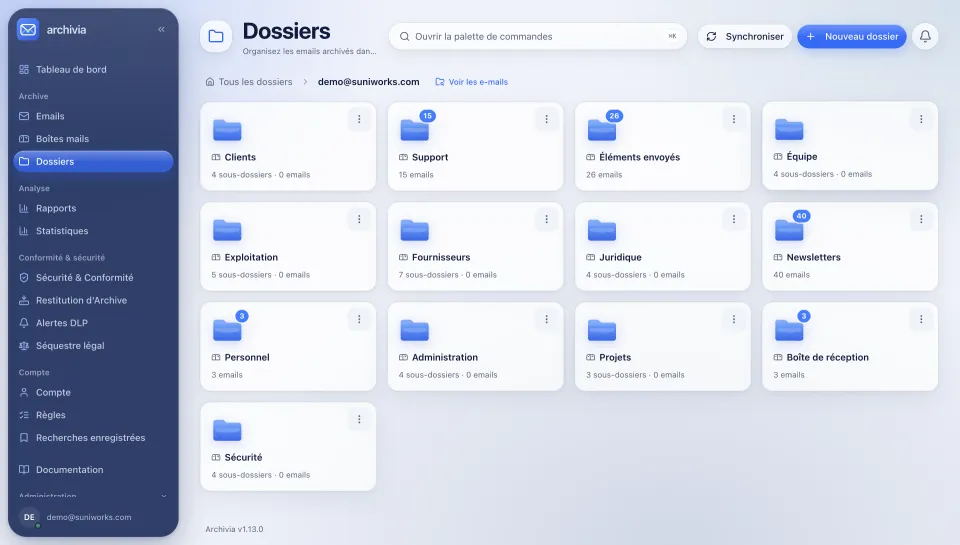
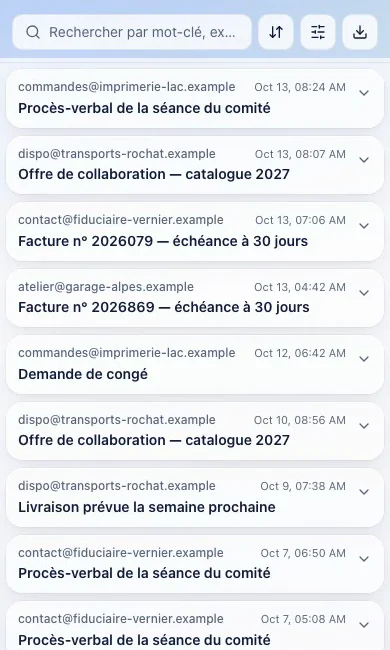
Always available, even after they leave.
Their emails stay accessible

Find the email and its attachment

Check the preserved history
Archivia gathers your emails from your current and former mail systems, keeps them safe and lets you find them whenever you need them.
Microsoft 365
Other sources(IMAP, PST, older archives)
A simple, powerful search to quickly find your past emails and all their attachments.
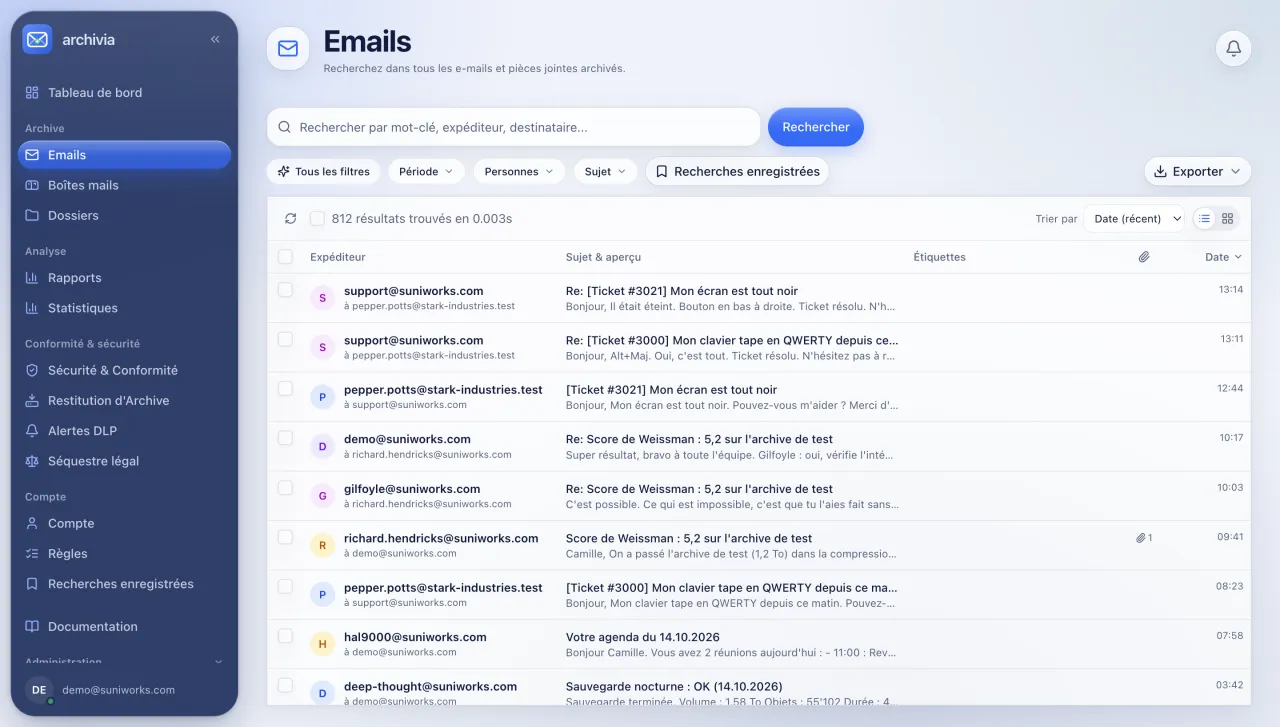
Open your archives from your browser, on a computer, tablet or smartphone.
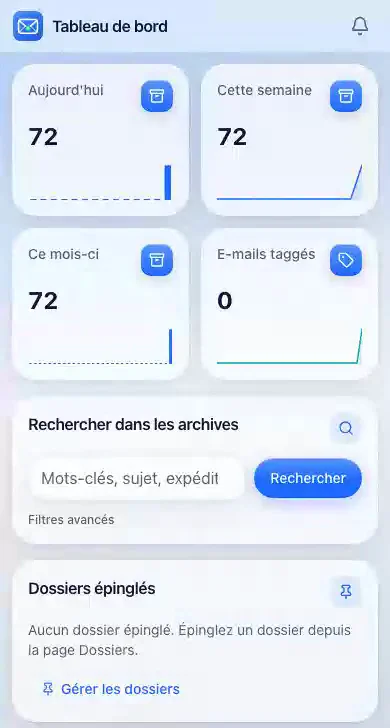
We help you bring in your current and past emails.
Your emails and attachments are stored in a secure space.
A simple search to reach the information quickly.
Archive a departed employee’s mailbox, then cancel their Microsoft 365 license. Prices in Swiss francs, excluding VAT.
Cancel departed employees’ Microsoft 365 licenses without losing their emails.
No long-term commitment
For the team’s active mailboxes: continuous synchronization and self-service access for every employee.
No long-term commitment
No long-term commitment · Instance ready within 15 minutes at most
The Swiss Code of Obligations (art. 958f) requires books and accounting records to be kept for ten years, in electronic form if their integrity is ensured. An email is concerned when it is itself an accounting record, such as an invoice or an order. Archivia keeps and finds your emails: AES-256 encryption, a SHA-256 fingerprint of every message, verifiable export. Retention periods depend on the nature of the documents. Define them with your accountant or your counsel.
Archivia is not certified. It provides tools: encryption, a fingerprint of every message, legal hold, a searchable audit log, verifiable export. Your organization’s compliance remains the responsibility of you and your counsel.
Yes, for the instance administrator. They can place whole mailboxes or the messages of a saved search under legal hold: while a hold is active, no message it covers can be deleted. They can also read a read-only audit log whose SHA-256 fingerprint chain can be verified. These functions have limits: verification does not detect truncation at the end of the log, and sign-out is not recorded in it.
Your archive can be exported at any time, in open formats. The terms for returning your data after cancellation, or if the service stops, are set out in the terms and conditions.
In part. With an E3 or E5 license and an administrator who configures retention, you get features that we do not have. Archivia brings an independent copy, search outside Outlook and a simple way to hand messages over, without keeping a license.
No AI is built into the offering: your emails are not sent to any model provider.
Your instance is ready within 15 minutes at most; the maximum set by our terms is 24 business hours. Connecting a mailbox then takes a few minutes.
We build your company’s instance and hand over a first administrator account. The administrator then opens access for others. On Full Protection, each employee can also find their own messages.
In Switzerland, on S3 storage that we operate ourselves. Each customer has its own storage space.
Give your company a lasting, accessible memory, simply.
Request a demo